- Bärbel Deisting
- 14.09.26
- 3 min
- Funding advice, Aerospace
Space technologies are no longer confined to realm of space exploration. They show up in daily lives far more often than most people realize. From ...



“Climate-neutral by 2035”, “Net Zero by 2040” — claims about future climate commitments like these are central to many sustainability strategies and are intended to build trust. But what happens when there is no solid plan behind the announcement? From 27 September 2026, the EmpCo Directive makes claims on future environmental performance directed at consumers subject to four clear conditions. If a key requirement is missing, the claim may be considered misleading.
Note: This article is provided for general informational purposes only and does not constitute legal advice. It is part of our blog series on the EmpCo Directive and the amendment to the German Act Against Unfair Competition (UWG). For an overview of the key principles, see the first article in the series, EmpCo Directive from September 2026: environmental claims under scrutiny.
In the previous post in this series, Climate-neutral through offsetting? What EmpCo will prohibit, we showed that product-related climate neutrality claims based on offsetting will generally be prohibited from 27 September 2026. However, promises and announcements such as “Net Zero by 2040” or “climate-neutral by 2035” are a different matter: They do not claim a current climate impact, but one to be achieved in future. The UWG does not prohibit such future-related claims outright, nor claims about other environmental performance, but it does make them subject to clear conditions.
Under Section 5(3) No. 4 UWG, in the version applicable from 27 September 2026, a claim about future environmental performance is misleading unless it rests on clear, objective, publicly available and verifiable commitments set out in a detailed and realistic implementation plan. In the second article of this series, EmpCo checklist: 6 steps for reliable environmental claims, we already classified this as a category of its own: claims about future environmental performance.
The requirements that apply to these statements, and how to meet them in practice, are explained in more detail below. The figure below provides an overview of the key steps involved.
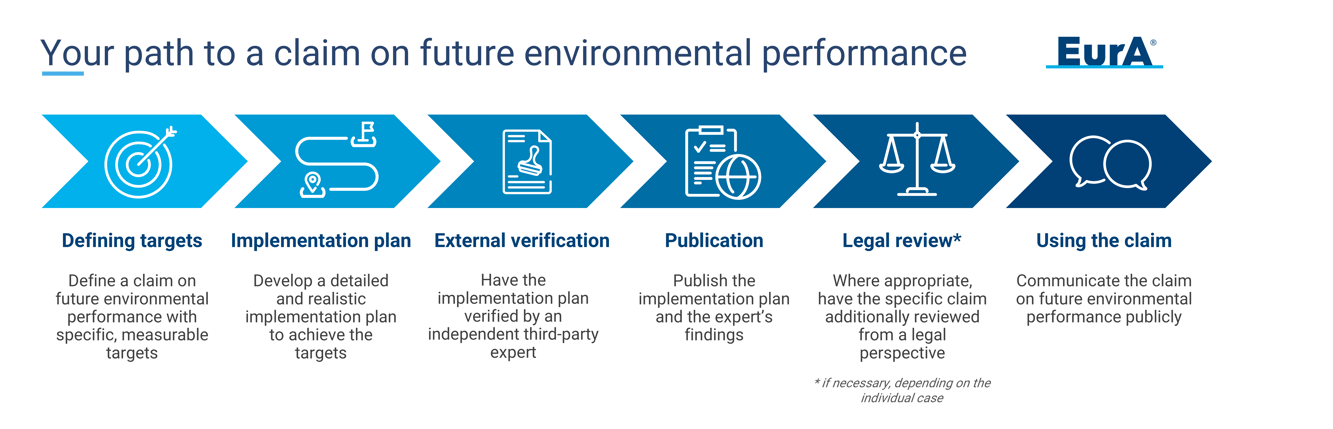
For a future environmental claim such as “Net Zero by 2040” to comply with the new requirements, four conditions must be met under the UWG. If any one of them is missing, the claim may no longer meet the applicable requirements.
The target must be formulated in concrete terms: It should be clear exactly what is being referred to (company, location, product category), as well as the scope and nature of the objective. A mere declaration of intent such as “we are aiming for climate neutrality” is not sufficient. Equally important, the target must be measurable — for example, through a defined percentage reduction — and time-bound. In practice, it is advisable to specify a concrete base year and target year.
A target on its own does not underpin future environmental claims. The UWG requires an implementation plan that is detailed and realistic. The measures it sets out need to be coherent and clearly aimed at achieving the stated goal.
The law explicitly cites the allocation of resources as an example of additional elements needed to support the implementation. These include, among other things, financial resources, clearly assigned responsibilities, and processes that ensure the plan is effectively embedded within the company — not just on paper, but in budget planning and day-to-day operational management.
The fourth condition concerns outside scrutiny: The implementation plan must be reviewed at regular intervals by an independent external expert, and the resulting findings must be made available to consumers. This requirement is explained in more detail below, as it differs significantly from the verification of a greenhouse gas inventory.
These elements are not an end in themselves: They also form the basis for an external reviewer to be able to understand and assess the plan in the first place.
A common point of confusion is the difference between two forms of review: the verification of a greenhouse gas inventory and the review of an implementation plan for a claim about future environmental performance.
Verifying a greenhouse gas inventory confirms that an existing carbon footprint has been calculated correctly, in line with recognised standards. It looks backwards, at emissions that have already been generated.
By contrast, the review required under the UWG for a claim on future environmental performance looks ahead: It assesses whether the underlying basis for the claim — including the targets, baseline, implementation plan and governance — meets the applicable requirements. This kind of review does not assess the economic viability of the measures, is no guarantee that the target will actually be met, and does not involve verifying the calculated greenhouse gas inventory. It does, however, provide the transparency required by law, with the findings made available to consumers.
In practice, this means a verified carbon footprint on its own does not fulfil the fourth condition. Companies also need a separate review of the implementation plan itself, carried out by an independent external expert, with the findings made available to consumers.
Companies that already communicate a climate target to consumers, or are planning to do so, should review their implementation plan against the four conditions sooner rather than later:
The same cut-off date applies to all four conditions: From 27 September 2026, there is no separate transition period. It is therefore worthwhile to develop a roadmap early on, rather than making last-minute adjustments shortly before the deadline.
Our accredited verification body also offers independent verification of greenhouse gas inventories in accordance with internationally recognised standards, providing additional assurance on the quality and reliability of the data underlying your climate targets and reduction pathways.
Planning to communicate an ambitious climate target such as “Net Zero” or “climate-neutral by …”? We can help you build the technical foundations, plan a structured pathway to your goal, and address the requirements for credible climate communication early on. We are also here to support you with the independent external review of implementation plans.
➔ Feel free to schedule a free initial consultation.
Sources and further information







EurA AG
T- 079619256-0Max-Eyth-Straße 2
73479 Ellwangen
info@eura-ag.com