- Levin Winzinger
- 24.09.26
- 8 min
- Success factor sustainability
Whether a leaf logo on packaging, a quality mark in an online shop, or a certification stamp on a brochure: sustainability labels can build genuine ...



The deadline for the European Defence Fund (EDF) for 2026 passed on 29 September. But remember: once the deadline has passed, it is time to start thinking about the next one. Now is the ideal time to start thinking about the 2027 submission deadline and to begin preparations in good time.
Claryfing the project idea, setting up the consortium, and drafting the application takes time – particularly in the increasingly competitive EDF environment, getting an early start is crucial.
The results regarding applications submitted for the deadline of 29 September 2026 can be expected in March 2027. The EU typically announces the selected projects publicly in the following April.
Then, the contract preparation phase begins for every successful consortium. The signing of the grant agreement with the European Commission is expected to take place between September and October 2027. The actual start of the project will then be around November or December 2027.
This means there is a considerable time lag between submission, the funding decision, and the actual start of the project. At the same time, preparations for the next call for proposals are already underway.
Competition for EDF funding has increased significantly in recent years. Whilst there has been a massive increase in the number of applications submitted in recent years, the number of projects receiving funding has remained roughly the same (see Figure 1). For example, in 2025, 410 proposals were received for the EDF calls for proposals, from which 58 projects were selected for EU funding totalling around 1.07 billion euros.
Competition for the available funding is particularly fierce in the open-topic (‘non-thematic’, NT) calls, especially as the budget share allocated to these has remained below ten per cent.
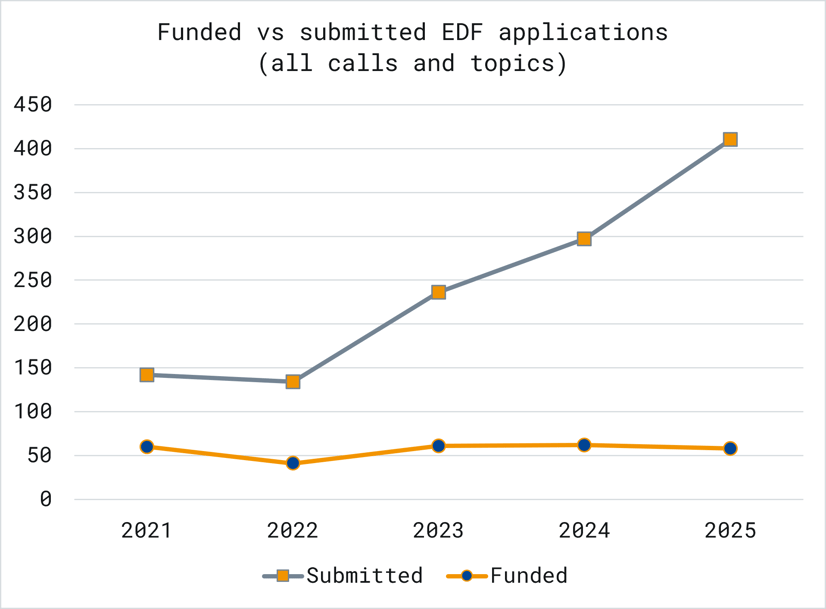
Figure: Number of submissions and funded projects in the European Defence Fund 2021 to 2025 (source: EDF Results Fact Sheets)
When submitting an application, it is therefore crucial to provide:
The application itself thus becomes a decisive competitive factor.
The EDF was established for the EU’s 2021-2027 financial framework. The 2027 call for proposals will therefore be the last within the EDF funding period.
However, policymakers are already looking ahead to the period beyond that. For the next Multiannual Financial Framework (MFF) 2028-2034, the European Commission has proposed a European Competitiveness Fund (ECF). The proposal allocates 131 billion Euros within the ECF to the areas of security, defence and space; however, this is not to be equated directly with a ‘new EDF budget’.
The specific details of the MFF 2028-2034 and the ECF have not yet been finalised. It is worth keeping an eye on the funding landscape from 2028 onwards from now, while the current EDF offers a concrete and established funding opportunity for 2027.
The finalised EDF work programme for 2027 has not yet been published. This is expected to take place at the end of 2026. However, no fundamental changes are anticipated compared with the previous work programmes for 2021 to 2026. The budget will be published alongside the work programme, but, based on previous years, a figure in the region of one billion Euros is likely. The exact submission deadline will also be published with the work programme and is expected to fall between the end of Q3 and the beginning of Q4 2027.
In line with its general principles, EDF will continue to fund projects in research and development (R&D) divided into the more fundamental Research Actions (RA) and Development Actions (DA) with higher technical maturity.
On the other hand, measures to increase the production capacities of the European defence industry are covered by the Industrial Reinforcement Actions (IRA) under the European Defence Industry Programme (EDIP).
In principle, EDF projects are still subject to the minimum requirement that a consortium must consist of at least three independent entities from three different EU Member States or EDF-associated countries. In practice, however, successful consortia are often considerably larger. For example, as the results from the 2025 EDF round show, projects comprised an average of 18 entities from nine countries.
For calls for proposals in the field of disruptive technologies (DIS), reduced minimum requirements regarding consortium size apply. The opportunities for involving Ukrainian stakeholders have also recently been expanded, for example through the so-called ‘Mini-Defence Omnibus’ 2025/2653.
A development of particular interest to smaller and start-up companies is the increased use of Financial Support to Third Parties (FSTP), often referred to as ‘cascade funding’. The 2026 Work Programme introduced the option to utilise FSTP in all EDF projects. This allows selected EDF projects to award financial support to SMEs and start-ups in turn. However, there is no obligation to utilise this in every EDF project.
This opens up additional opportunities for innovative SMEs and start-ups to get involved in European defence projects. Initial experience shows that this instrument is generating considerable interest: the first FSTP sub-call from an EDF project (‘MaJoR‘) received more than 200 applications.
Forming a consortium is often one of the most time-consuming steps. Defining the roles, responsibilities, and contributions of the individual partners in international consortia in a way that satisfies all parties can be a complex and protracted process. It is crucial to ensure that the consortium covers the skills required for the specific project as comprehensively and complementarily as possible, and to demonstrate strong European cooperation.
Particular attention must be paid to one specific requirement at a very early stage when a targeted call for proposals relates to a Development Action (DA). In such cases, the consortium must submit two Letters of Intent (LOI) by a national Ministry of Defence each with the application. Depending on the country involved, specific national procedures and deadlines apply. These are generally well in advance of the actual EDF deadline; depending on the country, the application deadlines for LOIs fall between May and August.
Potential participants in an application for a DA project should therefore check and initiate the relevant national processes at an early stage. By contrast, no such LOIs are required for participation in Research Actions (RA).
EurA supports companies and research organisations in planning a suitable European funding project in order to facilitate successful market entry or the strategic development of their market position.
For doing so, EurA provides support in areas including:
Particularly with a view to the upcoming 2027 EDF call for proposals, it is worth taking action at an early stage. Those who refine their project idea today, approach potential partners and identify the appropriate calls to target will gain a decisive head start.
Would you like to find out more about the services we offer in the security and defence sector?
Get in touch! We are looking forward to meeting you and working on joint innovation projects!
Additional information is available on our website: https://www.eura-ag.com/en/security-and-defence
Autor: Julian Seethaler
Sources and additional information:
AI was used for translation and drafting parts of this post.







EurA AG
T- 079619256-0Max-Eyth-Straße 2
73479 Ellwangen
info@eura-ag.com