- Marvin Gornik
- 22.09.26
- 5 min
- Success factor sustainability
“Climate-neutral by 2035”, “Net Zero by 2040” — claims about future climate commitments like these are central to many sustainability strategies and ...



Whether a leaf logo on packaging, a quality mark in an online shop, or a certification stamp on a brochure: sustainability labels can build genuine consumer trust, provided it is clear what they stand for and what they are based on. With the EmpCo Directive being transposed into the UWG, the requirements placed on sustainability labels will also change as of 27 September 2026. Not every environmental or social label will remain permissible after that date. What matters, among other things, are the criteria behind the label, its origin, and whether it is independently monitored. This article explains what sets an EmpCo-compliant label apart from one that is not, and why companies should now review their existing labels and any new labels they plan to introduce.
Note: This article is provided for general informational purposes only and does not constitute legal advice.
Sustainability labels are intended to provide consumers with an initial point of reference. They condense complex information about environmental or social characteristics into a symbol that is easy to recognise. For consumers, however, it is often difficult to tell what criteria underpin a label, who checks that those criteria are being met, and whether the label reflects independent certification or is a company’s own creation.
This is exactly where the EmpCo Directive comes in. It aims to counter misleading environmental claims and strengthen the transparency and credibility of sustainability labels in commercial, consumer-oriented communications. For an overview of the legal requirements and when they apply, see the first article in our EmpCo series: EmpCo Directive from September 2026: environmental claims under scrutiny.
One principle applies not only to sustainability labels but to sustainability communication more broadly: A label alone does not create trust. What matters are verifiable requirements, transparent procedures and independent oversight. Choosing and using a label therefore becomes a genuinely cross-functional task, calling for close coordination between marketing, sustainability management, procurement, product management, quality and compliance.
Because this practice falls under the UWG “blacklist”, no further assessment is needed as to whether the label actually influenced an average consumer’s purchasing decision. Using a sustainability label without either of these two foundations is prohibited outright.
This affects, in particular, company-owned marks that rest solely on internal criteria and internal assessment. Factually accurate content or an internal review alone is insufficient to provide a legal basis for a company’s own symbol.
However, this does not mean that every privately developed label is ruled out. According to the European Commission’s FAQ, the operator of a certification scheme and the company using a label based on that scheme may, in principle, be the same entity. What matters is that the underlying scheme meets every legal requirement — in particular, that compliance is monitored by a competent, independent third party that is legally separate from both the scheme operator and the certified company.
Not every certificate or audit automatically forms part of a certification scheme within the meaning of the UWG. The law sets out specific requirements for how such a scheme must be structured. A practical review can help companies determine whether these requirements are met.
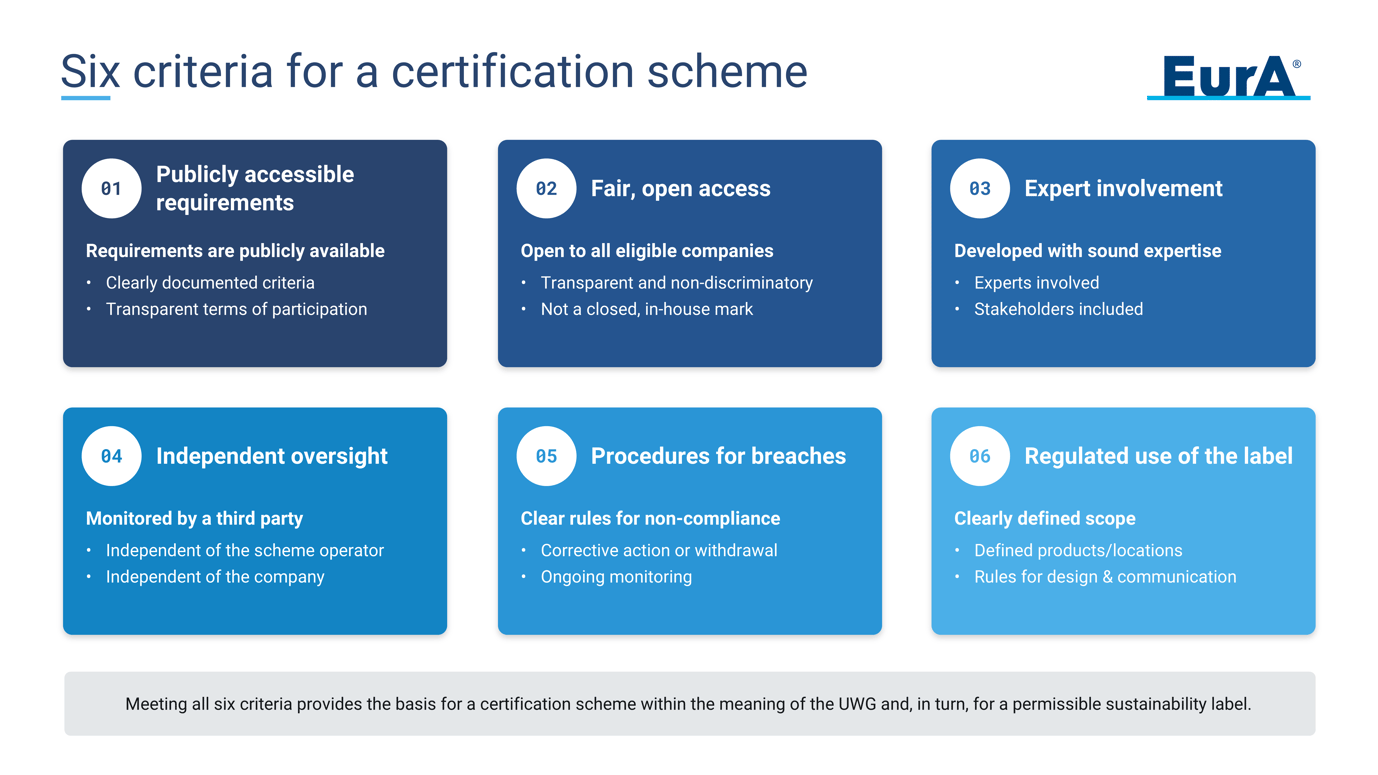
The scheme’s requirements must be publicly available. Outsiders must be able to understand which environmental or social criteria a product, process, or business activity has to meet.
A generic claim such as “we recognise particularly sustainable products” is not sufficient for this purpose.
The scheme must, in principle, be open to all companies willing and able to meet its requirements.
An in-house mark used exclusively for a company's own products, with no access for other market participants, will generally not meet this criterion.
The requirements of the certification scheme must be developed by the scheme operator with the involvement of relevant experts and stakeholders.
This helps ensure that criteria are not developed solely to serve the communication interests of a single company. Which specific stakeholders should be involved depends on the subject matter and scope of the scheme.
Compliance must be monitored by a third party that is independent of both the scheme operator and the certified company and has the necessary expertise.
A simple self-declaration, an internal audit, or approval by the company’s own marketing or sustainability department is not sufficient for this purpose.
A robust certification scheme requires established procedures for cases where participating companies do not — or no longer — meet the requirements. These include, for example, corrective actions, the suspension or withdrawal of the right to use the label.
For companies using the label, it is therefore not only the initial award that matters. Equally important is how regularly checks are carried out, which changes must be reported, and under what conditions the authorisation to use the label expires.
The certification scheme must set out how the corresponding sustainability label may be used. Companies should verify for which products, locations, processes, or business activities the use is authorised and what requirements apply to its design and accompanying communications.
Well-known labels can offer companies a useful first point of reference, but they are no substitute for a proper review of your own, and should never be treated as interchangeable examples, since different labels are based on different legal foundations and frameworks.
The EU Ecolabel and the Blue Angel are both examples of environmental labels established by public authorities: the EU Ecolabel is based on an EU regulation, while the Blue Angel is Germany's official state environmental label. Both are also Type I environmental labels under ISO 14024, and both rely on defined criteria together with independent assessment and award procedures.
ISO 14024 Type I itself is a different matter: It is not a specific label, but a standard for environmental labelling schemes. Whether an individual Type I label has been established by a public authority, or rests on a UWG-compliant certification scheme, has to be assessed on a case-by-case basis.
For general environmental claims that rely on such a label, the “recognised excellent environmental performance” described in our second EmpCo article also serves as a benchmark.
Energy efficiency classes must be distinguished from a voluntary sustainability label: The EU energy label is a mandatory labelling requirement for the covered product groups under EU law and therefore falls outside the UWG's definition of a voluntary sustainability label.
With regard to other voluntary environmental or social labels, no blanket approved list can be derived from the UWG. Companies instead need to assess, case by case, whether a particular mark meets the legal definition of a sustainability label, and whether it rests on a certification scheme with the features the law requires.
Even well-known labels must be assessed individually; recognition alone does not guarantee compliance.
Even where a sustainability label meets every requirement for its underlying basis, that does not mean any advertising claim can automatically be built on top of it. The specific way the label is used, and the communication that surrounds it, must also be accurate.
For example, the following would be problematic: “Our entire product range is sustainable, as confirmed by Label X.”
Particular caution is called for whereA label’s criteria and scope must always align with the specific claim being made. This principle is directly linked to the EmpCo checklist for reliable environmental claims: The reference object, the claim itself, the supporting evidence, and its period of validity must be clearly linked to one another.
Begin by creating an inventory of all marks in use – regardless of whether they are referred to internally as a label, certification, icon, badge, or rating – and assessing them against a standardised framework.
Important: As described in the first EmpCo article, neither the EU Directive nor the German implementing legislation UWG provides for any additional transition period beyond 27 September 2026. Packaging, labelling and marketing material carrying non-compliant labels must be brought into line by that date — regardless of when they were produced or first published.
 Credible sustainability communication requires a robust data foundation. That is exactly what we help companies build — from systematically collecting and assessing relevant sustainability data to developing a sound evidence base for substantiated environmental claims and embedding the results in operational processes.
In addition, the accredited verification body offers verification of greenhouse gas inventories and transition plans in accordance with internationally recognised standards.
➔ Are your sustainability labels and environmental claims ready for the new EmpCo requirements? We will work with you to identify exactly where data, evidence or wording may still need adjusting – and help build a solid foundation for credible sustainability communication: Click here to get in touch.
Sources and further information
.jpg)






EurA AG
T- 079619256-0Max-Eyth-Straße 2
73479 Ellwangen
info@eura-ag.com