- Dr Denise Ott
- 12.08.26
- 7 min
- Success factor sustainability
Would your current environmental claims stand up to an EmpCo review today? From 27 September 2026, the EmpCo Directive and Germany's amended Act ...



“Sustainable”, “green”, “energy-efficient” or “environmentally friendly” — in corporate communications, these terms are ubiquitous. What they actually mean, however, is often left unclear. Under the EmpCo Directive and the accompanying amendment to the UWG (the German Act Against Unfair Competition), such claims may become legally impermissible from 27 September 2026 unless they meet the applicable requirements and are supported by suitable evidence. This does not mean businesses must refrain from communicating about sustainability altogether. What matters is formulating environmental claims precisely, clearly defining their scope, and backing them with the appropriate data.
In the first article of this series, “EmpCo Directive from September 2026: environmental claims under scrutiny”, we outlined the EmpCo’s overall requirements and the types of environmental claims defined by the UWG. This article shows how to distinguish between these types in practice and how to substantiate them – and how a structured inventory of claims contributes to credible sustainability communication.
Note: This article is intended as general professional information and does not constitute legal advice.
Not every environmental claim is subject to the same requirements. As a first step, it therefore makes sense to sort existing claims by type – bearing in mind that the categories are not necessarily mutually exclusive: a claim can be general, forward-looking and compensation-related all at once. An initial classification helps companies set priorities and identify claims that most urgently need closer scrutiny.
A claim is classed as generic if it is not based on a sustainability label and if its specifics are not set out clearly and prominently on the same medium. The terms “specific environmental claim”, “claim on future environmental performance” and “offsetting-based claim” are not legal terms; in this article, we use them as practical categories to help structure environmental claims.
|
Type of claim |
How to recognise it |
Example |
Key point to check |
|
Generic environmental claim |
Not accompanied by a sustainability label and not clearly highlighted or specified on the same medium |
“This product is environmentally friendly.” | Always impermissible under the Annex to Section 3(3) UWG unless recognised excellent environmental performance relevant to the claim can be demonstrated |
| Specific environmental claim |
The environmental aspect, reference object and claimed performance are specifically defined |
“This bottle contains 70 percent recycled plastic.” | The evidence must support exactly this stated claim and must not imply any broader environmental benefit |
|
Claim on future environmental performance |
A target or promise relates to environmental performance to be achieved only in future | “We will cut our operational greenhouse gas emissions by 50 percent by 2030, compared with 2020.” | Requires clear, objective, publicly accessible, and verifiable commitments set out in a detailed and realistic implementation plan that is regularly reviewed by an independent external expert, with the findings made public |
|
Offsetting-based claim |
The claimed climate impact relies wholly or partly on offsetting greenhouse gas emissions | “This packaging is carbon-neutral through offsetting.” | Impermissible under the Annex to Section 3(3) UWG where a neutral, reduced or positive climate impact is based on offsetting alone |
|
Sustainability label |
A voluntary label that highlights a product, process, or company based on environmental or social characteristics | A proprietary leaf logo labelled “Sustainable Choice” | Must meet the requirements for a certification scheme (Section 2(2) No. 6 UWG) or be set by a public authority — an internal review process is not sufficient here |
Credible sustainability communication rarely comes down to individual statements, but is built primarily on structured internal processes and systematic claim management. This includes documenting claims already made or planned, verifying the underlying evidence, and updating them regularly.
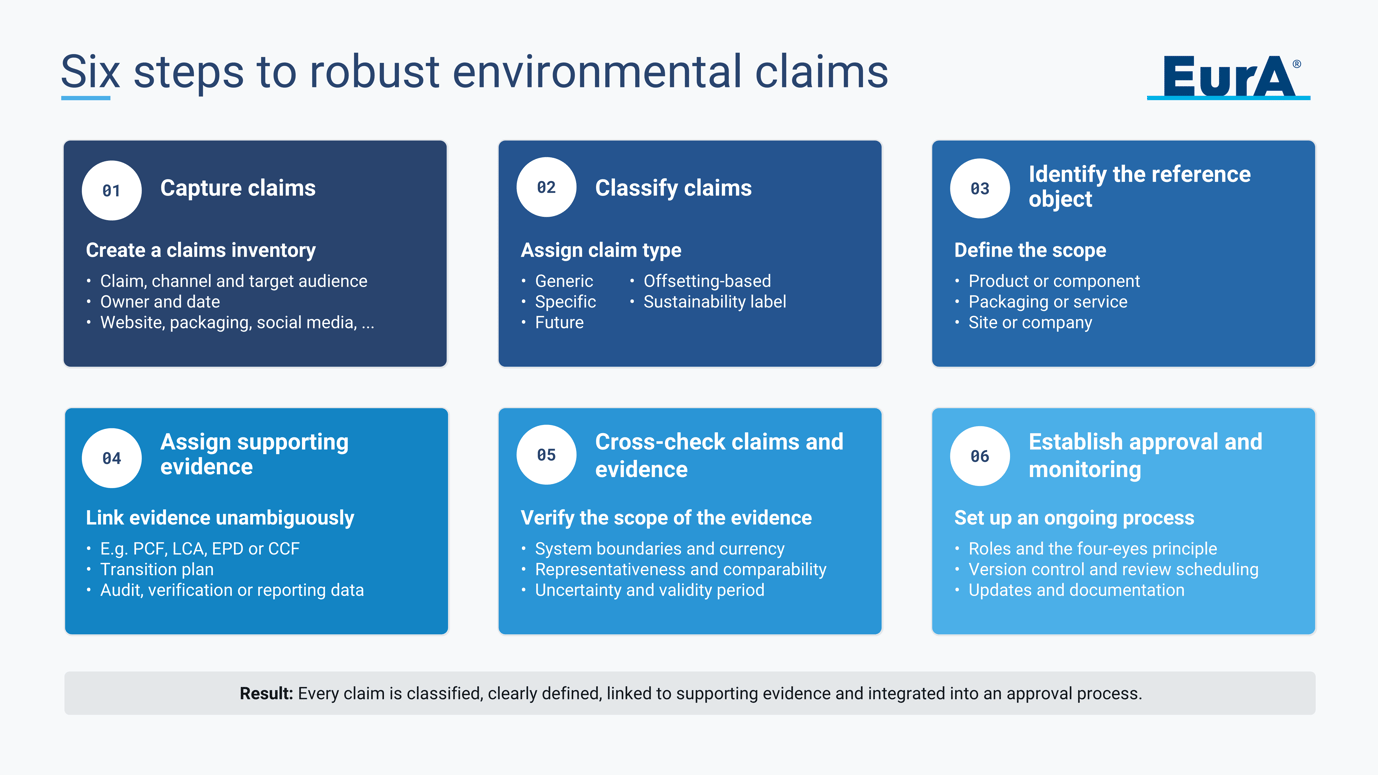
The first step is a structured claim inventory: the exact wording, the channel, the target audience, the responsible department, the publication date and planned duration of use. Do not just search for obvious terms like “sustainable”, “green” or “climate-neutral”. Capture every statement and design element with a possible environmental or sustainability connection — images, logos, and product names can convey an environmental claim too.
Typical places to look:This classification does not replace a case-by-case assessment, but it does help group claims that address similar issues and flag the most critical ones early on.
One of the most important questions when evaluating an environmental claim is: what the claim actually relates to.
Possible reference objects include, for example:A company that exclusively uses renewable energy in a single stage of production must not create the impression that the entire product or the company as a whole is climate-friendly. This is exactly the kind of claim prohibited under the “blacklist” in the Annex to Section 3(3) UWG, where the claimed performance actually relates only to a partial aspect.
A clear attribution is key. What matters here is not the volume of data, but whether it actually supports the specific claim. A PCF can support a claim about specific emissions, but that does not automatically make a product “sustainable” overall.
Once an environmental claim has been captured and linked to a data basis, the decisive step follows: does the specific claim actually align with the available evidence?
In particular, check the following:A 2024 ruling by the Federal Court of Justice illustrates just how important such clarification is: A fruit gum manufacturer had advertised its product as ‘climate-neutral’ without explaining the meaning of the term within the advert itself (case no. I ZR 98/23).
Which evidence can support which claim – and where PCFs, EPDs or verified greenhouse gas inventories provide a solid foundation – is something our next article in the EmpCo series will explore in depth, with a focus on robust product claims.
For claims on future environmental performance in particular, responsibility does not end with publication: the UWG will require regular review by an independent external expert, with the findings made accessible to consumers.
Simply dropping sustainability communication altogether is not the only way to respond to EmpCo. What matters far more is assessing closely which environmental performance metric can actually be substantiated and communicated precisely.
 Credible sustainability communication requires a robust evidence base. That is exactly what we help businesses build — systematically collecting and evaluating relevant sustainability data, developing a sound evidence base for defensible environmental claims, and embedding the results in their operational processes.
In addition, the accredited verification body offers the verification of greenhouse gas inventories and transition plans in accordance with internationally recognised standards.
Would you like to know which of your environmental claims will still hold up after September — and where evidence is still missing? In a free initial consultation, we will run the quick check with you, reviewing your most important claims, assigning them to the relevant claim types, and identifying the evidence base needed for each.
→ Get in touch to schedule an initial consultation and EmpCo quick check.
Disclaimer: A conclusive legal assessment of your specific case falls outside the scope of this professional support and should, where needed, be obtained from suitably qualified legal counsel.
Sources and further information
.jpg)





EurA AG
T- 079619256-0Max-Eyth-Straße 2
73479 Ellwangen
info@eura-ag.com