- Parisa Javadi-Marand
- 10.08.26
- 3 min
- EU funding programmes, Innovation fund
The Innovation Fund Heat Auction 2026 could help industrial companies bridge the economic gap between fossil-based and clean process heat. Looking ...



The Innovation Fund 2026 is likely to become more targeted, more SME-friendly and more focused on implementation readiness. For companies planning low-carbon or net-zero projects, this changes how applications should be prepared. The main takeaway from the 2026 stakeholder consultation is clear: technical innovation alone will not be enough. Projects also need a credible financing logic, a robust GHG case and a realistic pathway to implementation.
One of the clearest signals for applicants is that the Innovation Fund 2026 is likely to move away from a one-size-fits-all approach. Instead, the European Commission appears to be shaping the next call as a more differentiated funding framework with targeted routes for Net-Zero Technologies, SME-led and small-scale projects, maritime projects, and auction-based mechanisms such as hydrogen and heat. For companies preparing a proposal, this means that choosing the right funding route early may become just as important as the quality of the project itself.
The likely direction of the Innovation Fund 2026 can be summarised as one fund with several more targeted funding paths.
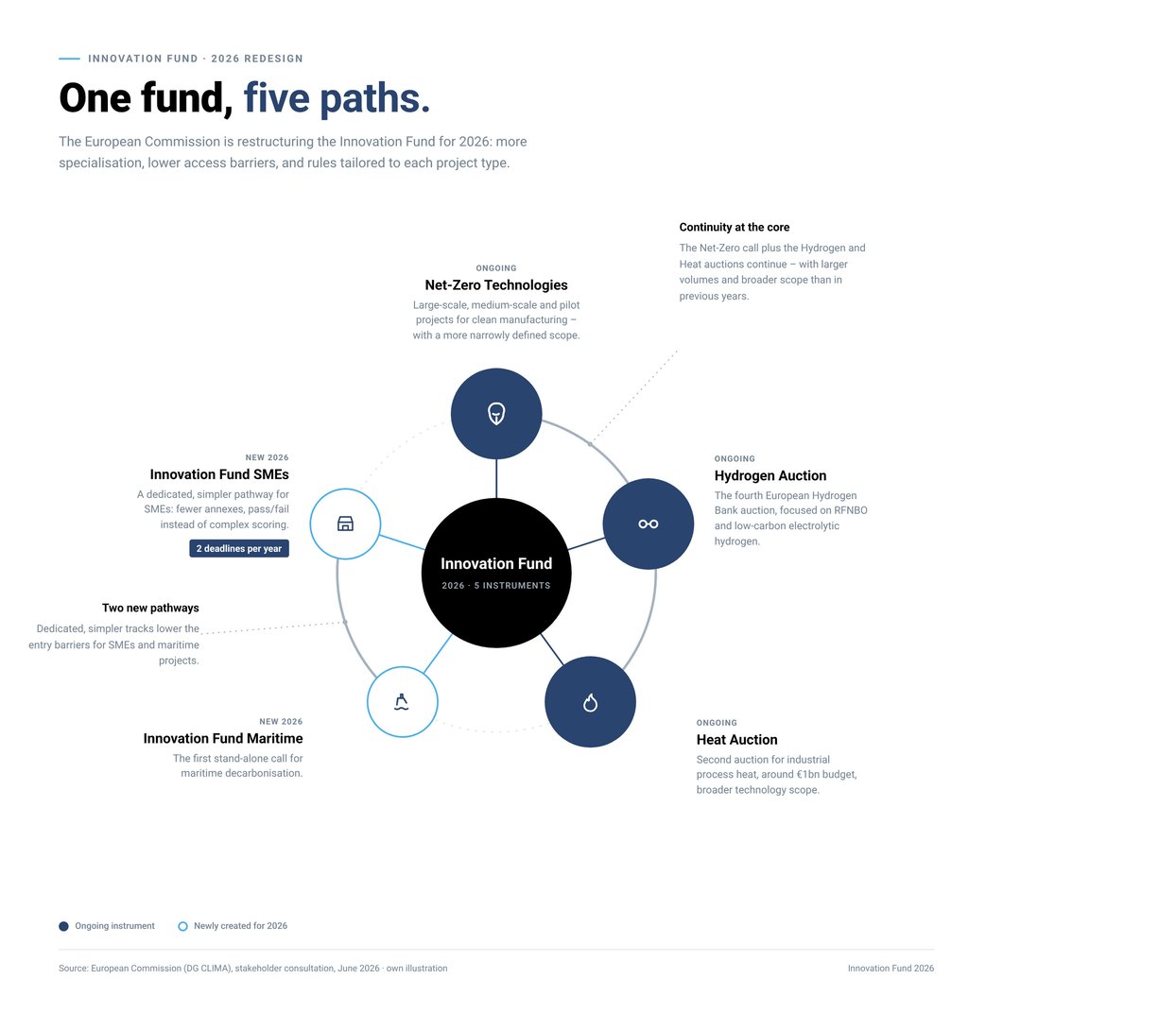
For SMEs and small-scale projects, the Innovation Fund 2026 may offer easier access and more flexible support. One option currently under discussion is an SME route with two cut-off dates, which would give companies more time to submit once their project is mature enough. Even if these dates are not final yet, they already serve as important planning signals for companies that need to organise internal resources, define responsibilities and prepare application documents early.
Another important takeaway is that future Innovation Fund calls 2026 are not expected to focus on innovation alone. The direction discussed at the consultation suggests that the programme should also improve the quality, speed and practicality of project implementation. In other words, applicants may need to show not only that their technology is innovative, but also that their project is realistic, financeable and ready to move forward.
For companies, the message is clear: the Innovation Fund 2026 is likely to favour projects that combine innovation, project maturity, financial credibility and implementation readiness. Early preparation will therefore be a clear competitive advantage.
One of the most important signals from the 2026 stakeholder consultation is the stronger focus on SME-led and small-scale projects. Although the Innovation Fund remains one of the most competitive EU funding programmes, the small-scale topic has been underused in previous calls. This suggests that many smaller innovative companies still face practical barriers when trying to access the programme.
To address this, the Innovation Fund 2026 is expected to place greater emphasis on accessibility, simplification and practical support for SMEs. A more dedicated SME route is currently being considered, alongside a simplified application process, fewer annexes, lower administrative effort, a simplified GHG calculator, lighter reporting requirements and more flexible cut-off dates.
For innovative SMEs, these changes could make the Innovation Fund 2026 easier to navigate and more realistic to apply for. This is especially relevant for companies with limited internal resources, small administrative teams and tighter financing capacity.
For companies preparing for the next Innovation Fund calls, early preparation will be essential. The likely direction of the Innovation Fund 2026 is already clear enough for companies to take action in five key areas:
The stakeholder consultation also highlighted one important point: internal readiness is a competitive advantage. In future Innovation Fund calls, projects are likely to be better positioned if they can demonstrate a credible path to implementation, a realistic financing structure and a concise but convincing impact case.
This means that companies should not focus on innovation ambition alone. In a highly competitive funding environment, projects that combine innovation, implementation readiness and financial credibility are more likely to succeed than projects with strong ideas but weaker execution planning.
Companies preparing for the Innovation Fund 2026 face a more complex funding landscape, stricter implementation expectations and higher pressure to prepare robust applications early. This is where EurA AG supports applicants in three closely connected areas: positioning, preparation and de-risking.
A strong application starts with the right strategic choice. EurA helps companies identify the most suitable funding pathway from the outset, whether a project is better aligned with the general Net-Zero Technologies route, a future SME-focused call, maritime topics or another relevant funding instrument.
As the Innovation Fund 2026 moves towards a more differentiated call structure, this early positioning becomes increasingly important. Choosing the right route helps companies avoid unnecessary effort, focus their internal resources more effectively and improve their overall competitiveness.
EurA also supports companies in the most demanding parts of the application process. This includes structuring the overall project logic, aligning technical maturity with business readiness, translating innovation into a credible market deployment strategy, developing a robust GHG case and coordinating the full proposal package.
By combining technical, commercial and financial expertise, supported by a dedicated GHG team, EurA helps companies prepare applications that are not only innovative, but also realistic, coherent and well supported by evidence.
Beyond proposal drafting, EurA helps companies reduce avoidable risks early in the process. This includes identifying critical gaps, challenging weak points in the application logic and exploring complementary support options where needed.
This approach is especially valuable for SMEs, which often work with limited internal resources, but it is equally relevant for larger industrial applicants preparing complex Innovation Fund projects.
The upcoming Innovation Fund calls are expected to create opportunities for a broad range of projects, from SME-led and small-scale innovations to large-scale industrial decarbonisation, as well as maritime, hydrogen and manufacturing projects.
With experienced expert teams and a strong track record in Innovation Fund applications, EurA supports companies of different sizes and project types throughout the full preparation process. This includes early project assessment, call selection, proposal development, GHG methodology, business planning, financial modelling and implementation strategy.
In this way, EurA helps companies navigate the evolving Innovation Fund 2026 landscape and prepare projects that combine innovation, maturity, financial credibility and implementation readiness.
Text: Parisa Javadi-Marand







EurA AG
T- 079619256-0Max-Eyth-Straße 2
73479 Ellwangen
info@eura-ag.com