- Julian Seethaler
- 10.07.26
- 2 min
- For SME, EIC Accelerator, EU funding programmes,
With an amendment to its 2026 work programme, the European Innovation Council (EIC) is, for the first time, allowing defence and dual-use ...



Whether in the construction, chemical or agricultural industries - many companies work with biogenic raw materials. But when it comes to carbon footprint calculation, biogenic and fossil carbon differ fundamentally. Depending on the accounting approach, this can lead to significantly different results with consequences for marketing, reporting and sustainability strategies. In this article, you will learn what matters most when it comes to biogenic carbon and how to select a methodology that delivers consistent and comprehensible results.
To produce a meaningful and reliable carbon footprint or life cycle analysis (LCA), it is essential to distinguish between fossil and biogenic carbon. Depending on the use case and LCA methodology implemented, the carbon balance and, consequently, the product carbon footprint (PCF) vary considerably.
Especially when comparing products, mixing different approaches can easily lead to misjudgments. This harbors risks - especially with regard to marketing claims, for instance in the context of the Green Claims Directive. Sound and consistent carbon accounting is therefore vital not only for accurate internal analysis but also for credible and legally compliant communication.
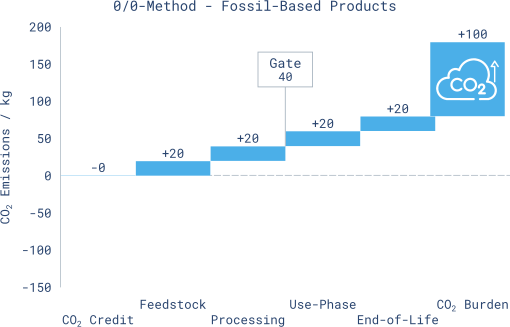
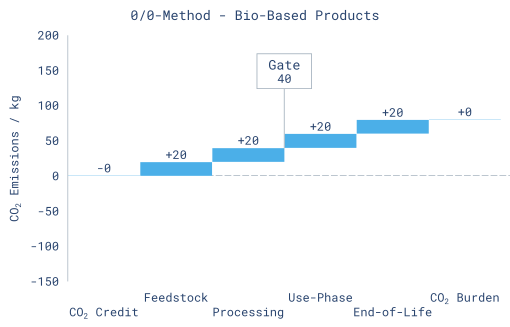
In the 0/0 approach, biogenic carbon is not accounted for: Neither the uptake of CO2 nor its subsequent release - for example through decay, combustion or use - is included in the balance. This approach assumes that new plant growth compensates for the emissions released in a timely manner, provided that the carbon cycle remains closed and no land-use changes occur.
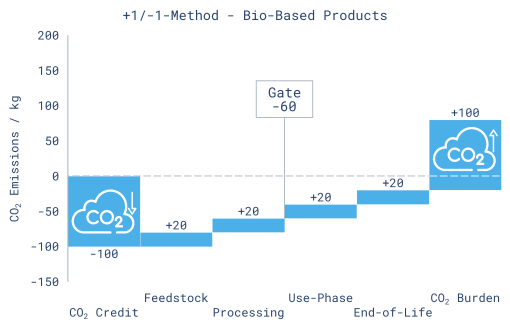
Advantages:In the +1/-1 approach, biogenic carbon is accounted for in a differentiated manner: CO2 uptake by plants is recorded as a negative credit (-1) and subsequent release as a positive emission (+1). This takes into account time lags in the carbon cycle and provides a more realistic representation of climate impacts.
Advantages:Assumption: Two fictional products - one fossil-based, one bio-based - undergo the same manufacturing process with identical CO2 emissions. As the biogenic CO2 is not accounted for under the 0/0 approach, the two products do not differ from each other until the end of production: both generate 40 kg of CO2 emissions up to the "gate". The difference only becomes apparent at the end of the life cycle, as only the fossil carbon is recorded here.
Under the +1/-1 approach, however, the advantage of the biogenic material becomes apparent immediately after production. It receives credit for the absorption of CO2,allowing for improved comparability between the products. This approach is frequently applied to bio-based products where carbon is stored over longer periods, such as wood products, land-use change scenarios, or agricultural and forestry processes.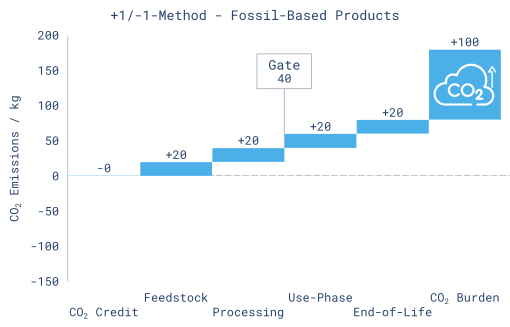
Since there are two different accounting approaches, the 0/0 and the +1/-1 approach, there is a risk that downstream partners will misinterpret the reported carbon balance. This is particularly relevant when +1/−1 results are communicated and incorporated into calculations based on the 0/0 approach without proper conversion. In such cases, the actual PCF may be significantly underestimated. Vice versa, the PCF may also be considerably overestimated if methodologies are mixed in the opposite direction.
To prevent misunderstandings and misleading green claims, it can be helpful to report values both with and without biogenic carbon. This ensures transparent documentation of the underlying accounting approach. Standards such as EN 15804 therefore require not only the declaration of CO2 emissions, but also the disclosure of the biogenic carbon content.
Methane (CH4) is produced during the fermentation or composting of biogenic materials - e.g. in biogas plants. Although the carbon it contains originally derives from the atmosphere, it is released not as CO2 but in the form of CH4. The problem: methane has a significantly higher global warming potential (GWP) than CO2 and has a significantly greater impact on the climate over a period of 100 years.
After some time in the atmosphere, methane oxidises back to CO2, which must also be considered in the assessment. This is particularly relevant for biogenic CH4, as the question arises here: does the original methane count - or the CO2 it later becomes?
The evaluation differs depending on the accounting approach:Under the +1/-1 approach, the global warming potential of both fossil and biogenic methane is considered identical (29.8 kg CO2e/kg), as the CO2 formed through the oxidation of CH4 is accounted for as +1 in both cases. It is assumed that the greenhouse effect of the gas remains the same, regardless of whether the carbon originally stems from fossil or biogenic sources.
A distinction is made in the 0/0 approach: Fossil methane is also set at 29.8, whereas biogenic methane is assigned only 27 kg CO2e/kg. Since the methane originates from a biogenic source and ultimately oxidises to biogenic CO₂ – which is not counted as an emission under the 0/0 approach – this reduces the accumulated climate impact over 100 years compared to fossil methane. Consequently, under the 0/0 approach, fossil methane has a higher global warming potential than biogenic methane.
The table below illustrates how different standards assess biogenic and fossil methane, as well as other carbon fluxes. The GWP values are taken from the IPCC report: 29.8 kg CO2e/kg for fossil methane and 27 kg CO2e/kg for biogenic methane. Some impact assessment methods, such as ReCiPe, use values from an earlier IPCC report (36.8 and 34 kg CO2e/kg respectively). In addition, up to version 3.11, there was an error in the ecoinvent database that incorrectly applied the reduced global warming potential for biogenic methane in methods with a +1/-1 approach (e.g. IPCC 2021, ISO 14067, EPDs according to EN15804).
|
CO2, absorption from air |
0 |
-1 |
0 |
| CO2, fossil |
+1 |
+1 |
+1 |
|
CO2, biogenic |
0 |
+1 |
0 |
|
Methane, fossil |
+29,8 |
+29,8 |
+36,8 |
|
Methane, biogenic |
+27 |
+29,8 |
+34 |
For companies, this means: carbon accounting is complex. Only those who understand the underlying standard can correctly interpret emission figures and communicate them effectively.
Our recommendation: consider the role of biogenic raw materials at an early stage in order to select the appropriate accounting logic. This not only influences your CO2 figures, but also the credibility and informative value of your reporting and marketing communication.
A consistent and transparent methodology protects against greenwashing accusations, builds trust among stakeholders and can make a targeted contribution to optimising ESG ratings.
 EurA is your partner for sophisticated, industry-quality CO2 assessments: whether PCF, LCA or EPD - we master complex data models, take regulatory requirements into account and deliver audit-proof results.
Our consultancy combines technical excellence with strategic added value. We analyse your value chain, work with you to select the appropriate methodology and ensure that your carbon footprint is not only robust, but also effective in communication.
Benefit from a precise and comprehensible CO2 balance and send a strong signal for the future of your company. Find out more here.
Biogenic carbon comes from organic materials such as plants or biomass that has absorbed CO2 from the atmosphere. During decomposition or combustion, the CO2 is released again without increasing the atmospheric concentration in the long term (assuming constant land use).
Fossil carbon is stored for millions of years and releases additional CO2 into the atmosphere when burned. Biogenic carbon circulates in a short natural cycle and therefore has climate impacts that need to be assessed differently.
If biogenic materials remain bound in a product over a longer period of time or if the benefits of a bio-based product are to be presented in a cradle-to-gate balance, the +1/-1 approach is more suitable.
The decisive factors are the use case, the product life cycle, data availability and the reporting objectives. Transparency about the chosen approach is crucial for credibility and comparability. Our experts are here to support you.
Text: Hannah Zachskorn and Levin Winzinger
.jpg)





EurA AG
T- 079619256-0Max-Eyth-Straße 2
73479 Ellwangen
info@eura-ag.com