- Lukas Trunck
- 05.10.26
- 4 min
- For start-ups, Grant management
For start-ups, the public sector can be an attractive market, but one that has often been difficult to access until now. New administrative ...



Climate change is no longer a future risk — its physical impacts are being felt today. According to the German Federal Environment Agency (Umweltbundesamt), the number of climate- and weather-related disasters worldwide has risen by around 35 per cent since the 1990s. Germany, too, has seen extreme weather events cause substantial economic damage, most notably the severe flooding in July 2021 in Rhineland-Palatinate and North Rhine-Westphalia, which caused an estimated €33 billion in damage.
For companies, the consequences can be significant: property damage, business interruption, rising costs, lost productivity, or disrupted supply chains. As climate-related extreme events grow more frequent and more severe, so does the need to take action. A systematic climate risk analysis helps organisations identify risks early on, estimate the potential financial impact, and build resilience in a targeted way.
Beyond its economic relevance, the topic is also becoming increasingly important from a regulatory perspective. Both the Corporate Sustainability Reporting Directive (CSRD) and the EU Taxonomy require a structured approach to climate-related risk. This article outlines the specific demands that must be met and explains how companies can develop a robust climate risk analysis that can be applied to both regulatory frameworks.
A climate risk analysis should never be limited to a general description of possible climate impacts. How much detail it requires depends on the regulatory context, and the EU Taxonomy and CSRD each place the emphasis differently:
For relevant, taxonomy-eligible economic activities, the EU Taxonomy calls for a robust climate risk and vulnerability assessment that identifies the relevant physical climate hazards, assesses their materiality and derives suitable adaptation measures. The analysis must be proportionate to the scale and expected lifetime of the economic activity in question.
The CSRD and the associated standard ESRS E1 (Climate Change) raise the bar further: Reporting companies must look beyond physical climate risks such as extreme weather and also assess the transition risks and opportunities created by the shift to a climate-neutral economy. This encompasses not only the company’s own operations but also the relevant upstream and downstream segments of the value chain, including suppliers, service providers and other partners. Climate scenarios can form the basis for this assessment. Under the revised ESRS, which become mandatory from the 2027 financial year, scenario analysis is optional. Where it is carried out, it must include at least one high-emissions scenario for physical climate risks and one 1.5°C-aligned scenario for transition risks and opportunities. The scenarios, data sources, time horizons, assumptions and limitations of the analysis should be explained transparently.
The following table concisely summarises the different focal points of the EU Taxonomy and the CSRD:
|
Aspect |
EU Taxonomy |
CSRD / ESRS E1 |
|
Scope of analysis |
The relevant taxonomy-eligible economic activity and its physical assets |
The company’s own operations plus the relevant upstream and downstream value chain |
|
Types of risk |
Physical climate risks, as a basis for adaptation measures and the DNSH (“Do No Significant Harm”) assessment |
Physical risks, as well as transition risks and opportunities |
|
Methodology |
Future scenarios aligned with the activity’s lifetime; often covering the next 10 to 30 years for larger investments |
Scenario analysis is optional; where used, it must include at least one high-emissions scenario for physical risks and one 1.5°C scenario for transition risks |
|
Time horizons |
Aligned with the expected lifetime of the economic activity |
Short-, medium- and long-term perspectives |
|
Adaptation measures |
Mandatory development and implementation for material physical risks |
Results are incorporated into strategy, transition plan and risk management |
Important: The precise application always depends on the economic activity concerned, the regulatory scope and the applicable technical screening criteria. There is no single methodology that fits every business — a climate risk analysis has to be tailored to the specific case.
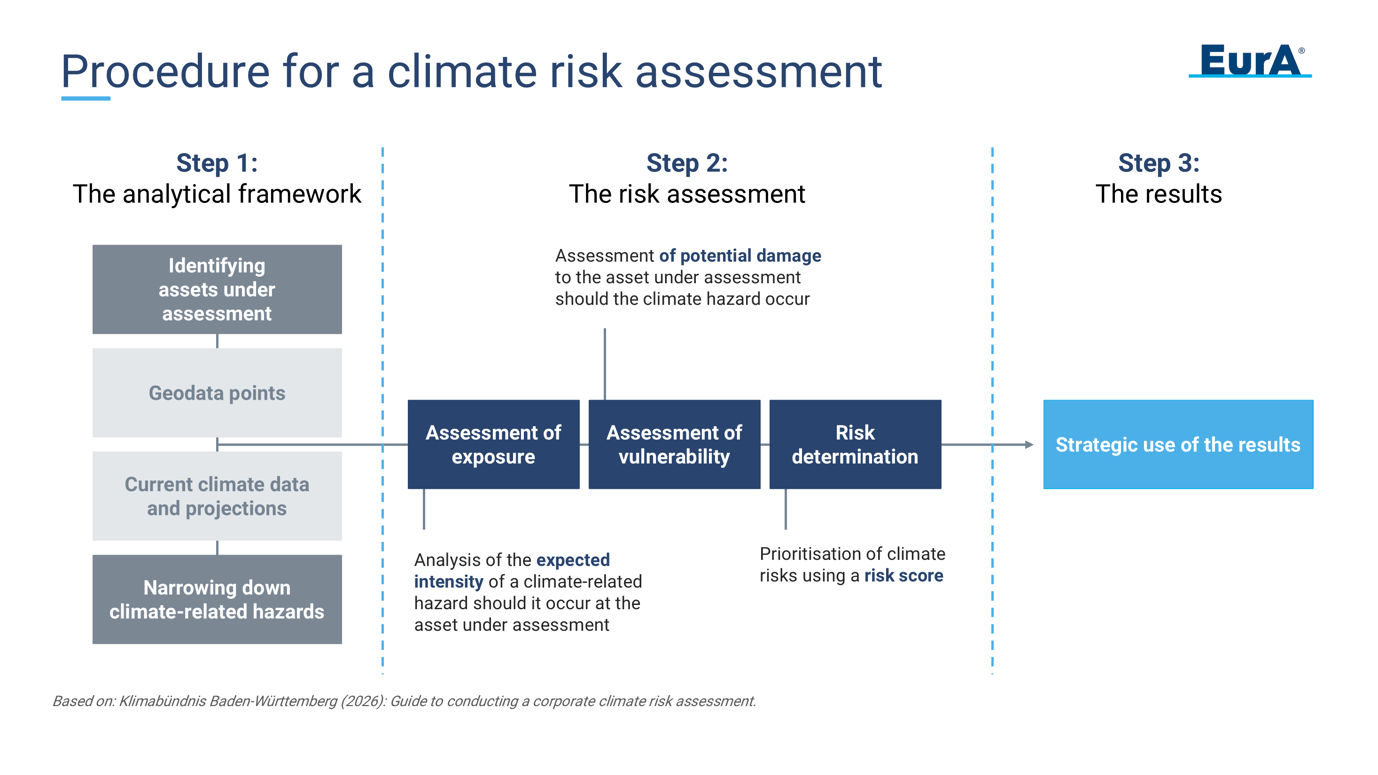
The starting point is deciding exactly what to examine. This involves identifying the key subjects of analysis, defining suitable time horizons, selecting appropriate climate scenarios and narrowing down the relevant physical climate hazards.
For a first climate risk analysis, it is advisable to focus initially on the most relevant subjects and broaden the analysis step by step as more data becomes available.
Clearly defining the subjects of analysis is a key prerequisite for any climate risk analysis. Depending on the business model and the scope of the assessment, this typically includes:A meaningful climate risk analysis should take various time horizons into account. After all, some climate risks will become apparent in the coming years, while others will only have an impact in the medium or long term.
Which periods to consider depends on both regulatory requirements and a company’s own planning cycles. The CSRD, for instance, requires an assessment of short-, medium- and long-term developments. The EU Taxonomy, by contrast, is guided by the expected lifetime of the economic activity and, for larger investments in particular, often calls for climate projections covering the next 10 to 30 years. The time periods commonly used by the IPCC offer a useful reference point: 2021–2040, 2041–2060 and 2081–2100.
Climate scenarios let companies compare possible future trajectories and derive potential risks from them. A meaningful analysis should consider at least two scenarios — for example, a moderate scenario such as RCP4.5 and a high-emissions scenario such as RCP8.5:
RCP4.5, a medium-emissions scenario, assumes effective climate mitigation measures that stabilise greenhouse gas concentrations over the course of the century. RCP8.5, the high-emissions scenario, instead describes a trajectory with very high emissions and correspondingly severe physical climate impacts.
For transition risks, however, scenarios that depict different political, technological, and economic development paths are relevant. What matters is that the chosen scenarios are plausible, relevant to the company and appropriate to the time horizon in question — and that their origin and underlying assumptions are made transparent.
Annex A of the EU Taxonomy provides a standardised classification that serves as a useful reference point here. It distinguishes between acute events and chronic changes, and groups them into four categories: temperature-related, wind-related, water-related and solid mass-related.
|
Type of hazard |
Temperature-related |
Wind-related |
Water-related |
Solid mass-related |
|
Chronic |
Temperature change (air, freshwater and seawater); heat stress; temperature variability; permafrost thawing
|
Changing wind patterns |
Changing precipitation patterns (rain, hail, snow, ice); precipitation and hydrological variability; ocean acidification; saline intrusion; sea-level rise; water scarcity |
Coastal erosion; soil degradation; soil erosion; solifluction |
|
Acute |
Heat wave; cold wave/frost; forest and wildfires |
Cyclone, hurricane or typhoon; storm (including snow, dust, and sandstorms); tornado |
Drought; heavy precipitation (rain, hail, snow, ice); flooding (coastal, river, pluvial, and groundwater); glacial lake outburst floods |
Avalanche; landslide; subsidence |
(Source: Delegated Regulation (EU) 2021/2139, Annex A)
Not every hazard will be relevant at every location. Which hazards are actually assessed should be substantiated and documented on technical grounds — hazards that are not relevant may be screened out, provided the reasoning is clearly set out.
The risk assessment centres on two questions: To what extent is a site exposed to a climate hazard, and how sensitively does it respond? The specific climate risk results from the combination of exposure and vulnerability.
Exposure describes the extent to which a location, facility, or another business unit is exposed to a climate hazard, measured using suitable indicators such as the number of hot days, peak temperatures, heavy rainfall events, flood levels or wildfire risk.
Historical weather data, satellite data and climate projections form the basis for this, supplemented by sources such as the German Meteorological Service (DWD), Copernicus or regional climate atlases.
It is particularly important that the data used matches the specific climate hazard. While broad-scale climate data is often sufficient to assess heat exposure, flood and heavy rainfall risks usually demand a much closer look at local conditions.
The outcome is an exposure value for each climate hazard, showing how strongly a subject of analysis could be affected by the impacts of climate change, now and in future. For buildings, infrastructure and other long-lived assets, long-term climate projections should also be taken into account.
Vulnerability describes how susceptible the subject of analysis is to the consequences of a climate hazard. It takes particular account of its sensitivity and its existing adaptive capacity.
A site might be heavily exposed to heat, for example, yet remain only moderately vulnerable thanks to good building insulation, shading, redundant cooling systems and established heat-protection plans. Conversely, even moderate exposure can translate into high risk where critical production processes or employees are particularly sensitive.
The assessment should therefore weigh technical, organisational, personnel and financial factors together.
Exposure and vulnerability are brought together into one single, consistent risk assessment. As the figure shows, the specific climate risk can be calculated by multiplying the exposure score by the vulnerability score, which brings into focus those subjects that are both highly exposed and especially vulnerable. Alternatively, additive or weighted methods can be used. What matters is not the mathematical sophistication, but a transparent and reproducible derivation of the results.
Clear thresholds should define when a risk is considered high, ideally aligned with the company’s existing risk management framework.
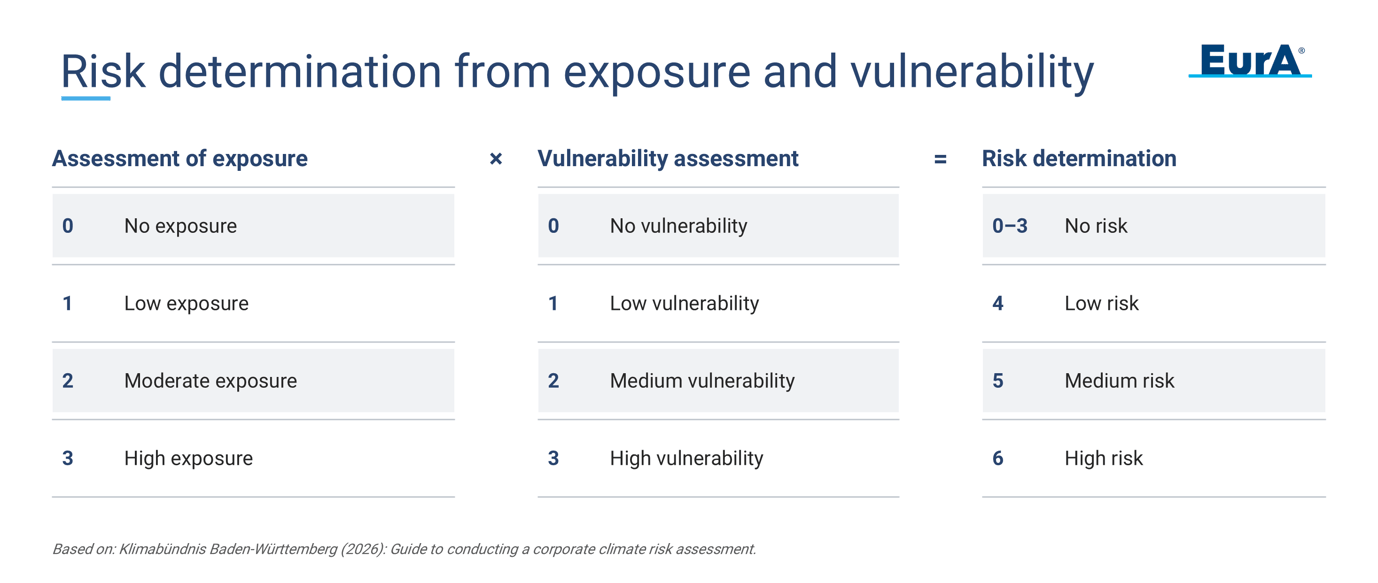
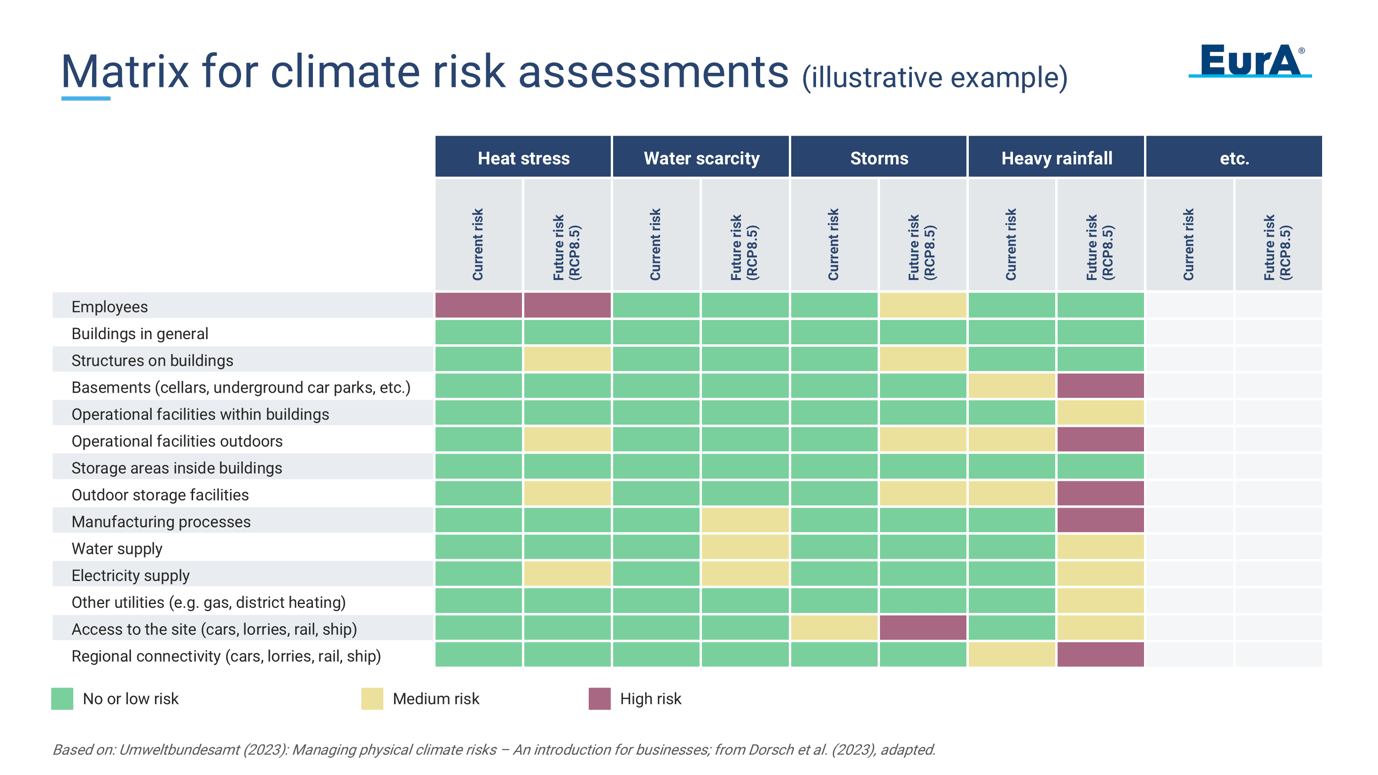
A risk matrix offers a straightforward way to present the results:
A climate risk analysis brings transparency to the climate-related risks a company faces. Its benefits, however, extend far beyond mere risk identification: The insights it generates form an important basis for strategic decisions, investment and long-term business development.
The results also lay the groundwork for systematic climate risk management and embedding clear responsibilities and decision-making processes into corporate governance.
From systematically analysing physical and transition climate risks through to developing concrete adaptation measures, our sustainability consulting team supports you end to end on the path to climate-resilient corporate management.
Our support includes:The result: a climate risk analysis that provides a robust foundation for CSRD/ESRS and EU Taxonomy reporting, while helping you make forward-looking investment decisions, avoid business disruption and safeguard your competitiveness for the long run.
➔ Would you like to set up your climate risk analysis, have existing results reviewed, or simply get a free initial assessment of the right strategic next steps for your company? Get in touch with our sustainability experts.
Sources and further information:
German Federal Environment Agency: Addressing Physical Climate Risks in the Financial Sector (2023)






EurA AG
T- 079619256-0Max-Eyth-Straße 2
73479 Ellwangen
info@eura-ag.com